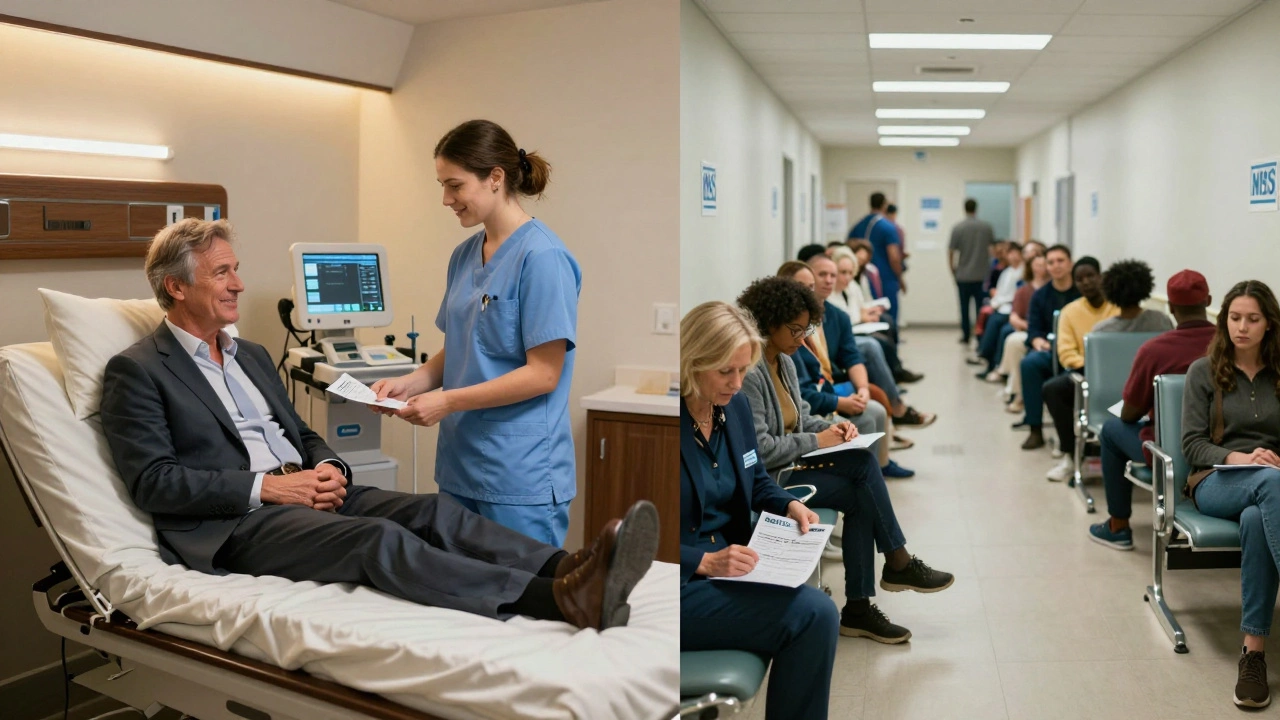
Private Healthcare Cost Calculator
Cost Estimator
Estimate your annual private healthcare costs and understand coverage limitations compared to the NHS
Key Insight
Private healthcare may seem like a shortcut, but often costs more than expected while offering limited coverage. Even with insurance, you could face significant out-of-pocket expenses for procedures that might be covered by the NHS.
Private Healthcare Costs
Annual Insurance Cost
Procedure Cost
Coverage Limitations
NHS Comparison
Cost to You
Free at point of service
Wait Times
Continuity of Care
Full continuity with your GP
Important Note
Private insurance often has significant exclusions. You may not receive the coverage you expect when you need it most. The NHS provides comprehensive care without hidden costs or exclusions.
Private healthcare in the UK sounds like a quick fix-skip the waiting lists, get seen faster, choose your doctor. But for many, it’s not the smooth ride it’s made out to be. Behind the glossy brochures and promises of luxury wards lie real, everyday problems that don’t show up in ads. If you’re thinking about switching from the NHS to private care, here’s what most people don’t tell you.
It’s expensive-and costs keep rising
Private healthcare isn’t cheap. A basic private health insurance plan in 2026 starts at around £1,500 a year for a single adult. Add a partner or kids, and that jumps to over £4,000. That’s before you even step into a hospital. And it’s not a one-time fee. Premiums go up every year, often by 10% or more, especially if you’re over 40 or have a minor health issue. A minor surgery like a knee arthroscopy might cost £8,000 out-of-pocket if you’re not insured. Even with insurance, you could still pay hundreds in excess fees or co-pays.
Compare that to the NHS, where you pay nothing at the point of care. You don’t get billed after an MRI, a hip replacement, or chemotherapy. In private care, every test, every consultation, every bandage has a price tag. And if your insurance doesn’t cover it-like dental, mental health, or some chronic conditions-you’re on your own.
Not everything is covered
Private insurance policies are full of fine print. Many exclude pre-existing conditions entirely. If you had back pain last year, your insurer might refuse to cover any spinal treatment for five years. Some won’t cover fertility treatments, cosmetic procedures, or even certain types of cancer drugs if they’re deemed "not cost-effective." Mental health care is often capped at just 10 sessions a year, even though recovery can take months.
And then there’s the "exclusions list." You might think you’re covered for heart surgery, but if your policy says it doesn’t cover "elective procedures performed outside a listed hospital," you could be stuck paying thousands if your surgeon isn’t on their approved list. These restrictions aren’t obvious until you need care-and by then, it’s too late to switch.
It doesn’t fix NHS delays for everyone
A lot of people buy private insurance hoping to bypass NHS waiting lists. But here’s the catch: even if you’re privately insured, you still need an NHS referral to get started. Many GPs won’t refer you unless you’ve tried NHS pathways first. And if your condition is serious enough to need urgent care, the NHS will still treat you-private insurance doesn’t give you priority in emergencies.
Plus, private hospitals often have fewer specialists than NHS centres. A rare cancer treatment might only be available at one NHS hospital in the whole country. Your private insurer might not have a contract with that hospital, so you’re forced to wait anyway. The result? You pay more, but you don’t always get faster access to the care you actually need.
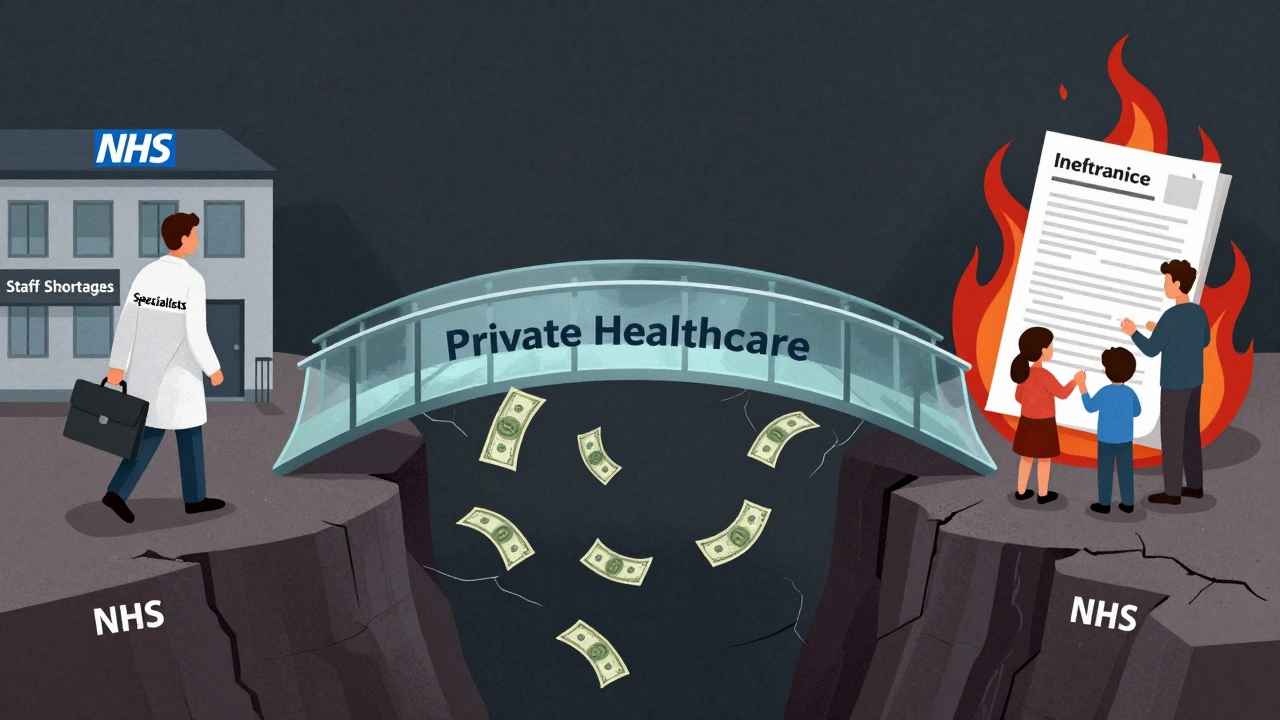
You lose continuity of care
On the NHS, you usually see the same GP for years. They know your history, your allergies, your family background. In private care, you’re often shuffled between different consultants, clinics, and hospitals. One specialist handles your diagnosis, another does the surgery, a third manages your recovery. No one has the full picture.
There’s no central record. Your private hospital doesn’t automatically share your notes with your NHS GP. If you have a complication after a private procedure, your GP might not even know what was done. That creates dangerous gaps. A 2024 report from the King’s Fund found that 37% of private patients experienced delays or errors because their care wasn’t properly coordinated between providers.
It creates a two-tier system-and it’s getting worse
Private healthcare doesn’t just exist alongside the NHS. It’s slowly draining it. Consultants who work for the NHS often take private patients on the side, sometimes scheduling their NHS appointments around private ones. Some NHS hospitals now rent out operating theatres to private firms during off-hours. That means fewer slots for NHS patients. A 2025 audit showed that in some regions, private use of NHS facilities has pushed back elective surgery waits by an extra 6-8 weeks.
And when the best doctors leave NHS roles for higher-paying private jobs, the quality of public care suffers. It’s not just about money-it’s about talent. The NHS is losing specialists to private clinics that offer better pay, better hours, and no bureaucracy. That weakens the system everyone else depends on.
It’s not always better quality
Just because it’s private doesn’t mean it’s better. A 2023 study by the Health Foundation compared outcomes for hip replacements in NHS and private hospitals. The results? No significant difference in recovery time, complication rates, or patient satisfaction. In fact, NHS hospitals often have higher volumes of complex cases, which means their teams are more experienced with rare complications.
Private hospitals focus on profitable, low-risk procedures-knee replacements, cataracts, hernias. They avoid high-risk, high-cost cases like major trauma, stroke rehab, or long-term cancer care. That’s why they can promise quick turnarounds. But if your condition is complicated, you might be better off in an NHS specialist centre.

It’s hard to switch back
Once you go private, it’s not easy to return to the NHS. If you stop paying your insurance, you can’t just snap your fingers and get back on the NHS waiting list. You’ll be treated as a new patient, with no priority-even if you’ve been waiting for years before you went private. Your NHS GP might not even remember your history if you’ve been out of the system for a while.
And if you develop a chronic condition while privately insured, insurers might drop you or hike your premiums to unaffordable levels. You’re left with no coverage and no easy path back to public care. That’s a trap many people don’t see until it’s too late.
It doesn’t help the most vulnerable
Private healthcare is a luxury. It’s designed for people who can afford it. That leaves behind those who can’t-low-income families, gig workers, retirees on fixed incomes. They’re stuck with the NHS, which is already stretched thin. Meanwhile, private care grows, funded by those who can pay, and the public system gets weaker.
This isn’t just unfair. It’s unsustainable. When only a small group gets fast, high-quality care, the rest are left waiting longer, with fewer resources. The gap widens. And over time, the NHS becomes a system for the poor, while the rich get something better.
What’s the real trade-off?
Private healthcare in the UK offers speed and comfort-but at a steep price. You pay more, get less coverage, risk being dropped by insurers, lose continuity of care, and indirectly harm the public system everyone else relies on. For some, it’s worth it. But for most, it’s a gamble that doesn’t pay off.
If you need care now, the NHS still works. It’s not perfect, but it’s there for everyone. Private care might feel like a shortcut, but it often leads to a dead end.
Is private healthcare faster than the NHS in the UK?
It can be, but not always. For routine procedures like cataract surgery or knee arthroscopy, private care often has shorter waits-sometimes just days. But for complex or rare conditions, the NHS still has the expertise and equipment. Many private hospitals don’t offer certain treatments at all, forcing you to return to the NHS anyway. Also, you still need an NHS referral to start the process, which can add delays.
Can I use private healthcare and still be on the NHS?
Yes, but with limits. You can use private insurance for some treatments while still receiving NHS care for others. But if you’re treated privately for a condition, your NHS GP may not be informed, which can lead to fragmented care. Also, if you’re referred for an NHS service while privately insured, you’ll usually be placed on the same waiting list as everyone else-you don’t get priority.
Does private health insurance cover mental health?
Some plans do, but coverage is often limited. Most policies cap therapy sessions at 6-10 per year and exclude long-term conditions like severe depression or PTSD. Medication and inpatient psychiatric care are frequently excluded. The NHS still provides free mental health services, though waiting times can be long. Private insurance won’t replace that-it just adds a small, restricted layer on top.
What happens if I can’t afford private insurance anymore?
If you stop paying, your coverage ends immediately. You can’t claim for anything that happened after your last payment. You’ll be treated as a new NHS patient, with no priority-even if you were previously on a long waiting list. If you have a chronic condition developed while insured, insurers may refuse to cover it in the future. You’re back to square one, with no safety net.
Are private hospitals better equipped than NHS hospitals?
Not necessarily. NHS hospitals handle far more complex cases, which means their staff are more experienced with emergencies and rare conditions. Private hospitals focus on profitable, low-risk procedures. They often lack intensive care units, trauma centres, or specialized cancer units. A private hospital might have nicer waiting rooms, but that doesn’t mean better outcomes.