Online Prescription Legality Checker
Determine if your online prescription request is likely legal and safe based on UK and Ireland regulations.
You wake up with a sore throat, a rash, or just need a refill on your regular medication. Instead of waiting weeks for an appointment or standing in a clinic queue, you book a video call with a doctor. They examine you via webcam and send a prescription to your local pharmacy. It sounds convenient, but it also raises a nagging question: is this actually legal?
The short answer is yes. In both the United Kingdom and Ireland, online prescriptions are fully legal, provided specific medical and regulatory standards are met. However, "legal" doesn't mean "unregulated." There are strict rules about when a doctor can prescribe remotely, what medications they can issue, and how they must verify your identity.
If you have been hesitant to use digital health services because you aren't sure if they are legitimate, you are not alone. Let's break down exactly how the law works, what protections you have, and where the lines are drawn between helpful care and risky shortcuts.
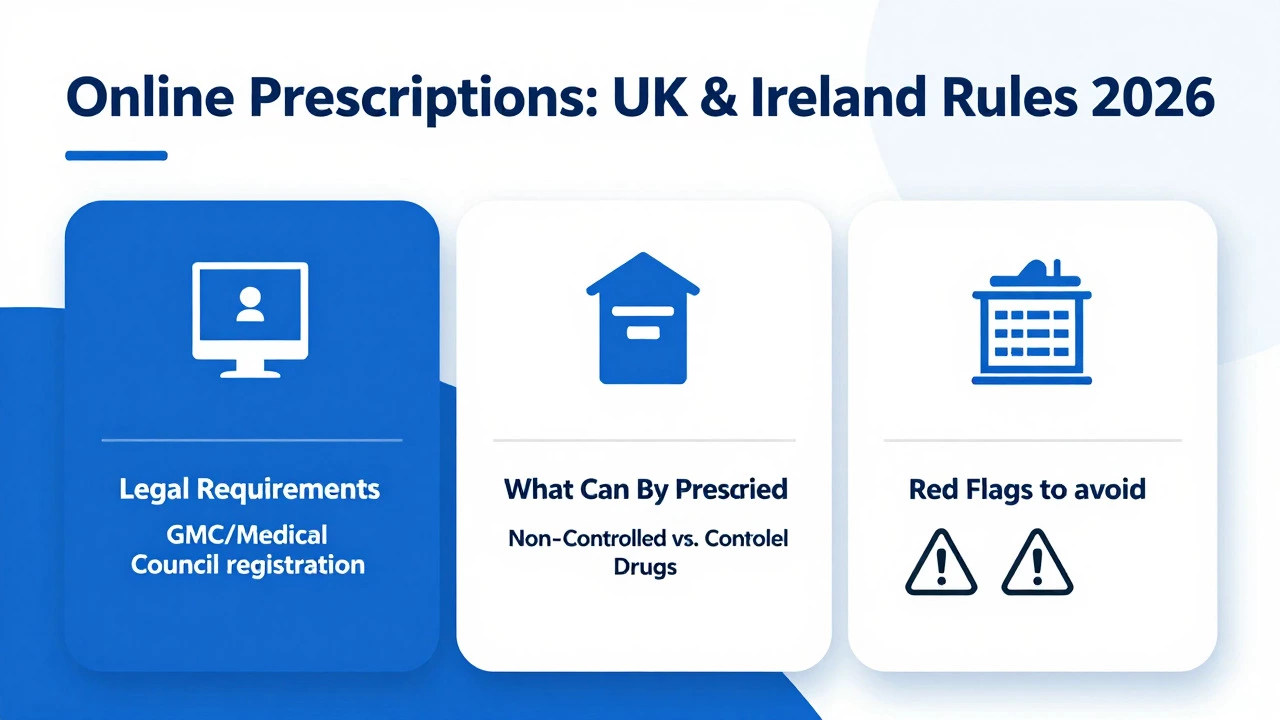
How the Law Defines Remote Prescribing
To understand if an online prescription is legal, we first need to look at who is allowed to write it. A prescription isn't just a piece of paper (or a digital file); it is a legal document that authorizes the dispensing of medicine. Therefore, the person issuing it must be a registered medical professional.
In the UK, doctors must be registered with the General Medical Council (GMC). In Ireland, they must be on the register maintained by the Medical Council. When you use a reputable telehealth platform, the clinician reviewing your case holds one of these registrations. If a website allows unqualified staff to issue scripts without proper oversight, that service is operating illegally.
The key legal concept here is the "therapeutic relationship." Historically, this required a face-to-face meeting. Today, guidelines from bodies like the Royal College of General Practitioners (RCGP) state that a therapeutic relationship can be established digitally, as long as the doctor has sufficient information to make a safe clinical decision. This means the legality hinges on the quality of the consultation, not just the medium used.
| Requirement | UK (England/Wales/Scotland/Northern Ireland) | Ireland |
|---|---|---|
| Doctor Registration | Must be GMC registered | Must be Irish Medical Council registered |
| Consultation Type | Video or phone; text-only often insufficient for new conditions | Face-to-face video preferred for initial assessments |
| Data Protection | GDPR compliant; data stored securely | GDPR compliant; HSE standards apply for public services |
| Prescription Format | Digital signature required for NHS/e-prescribing | Digital signature required for private/HSE integrated systems |
What Can and Cannot Be Prescribed Online
Not every medication is eligible for remote prescribing. The law places stricter controls on certain classes of drugs to prevent misuse and ensure patient safety. Understanding these categories helps you know what to expect from a legitimate service.
Non-Controlled Medications are drugs that do not have high potential for addiction or abuse. These include antibiotics for common infections, antihistamines for allergies, birth control pills, and treatments for acne or hair loss. These are widely available through online consultations because the risk profile is low, and the symptoms are usually self-reported accurately.
Controlled Drugs are medications with a higher risk of dependence, such as strong painkillers (opioids), ADHD stimulants, and some anxiety medications. The rules here are much tighter. In the UK, under the Misuse of Drugs Regulations 2001, a doctor generally needs to have seen the patient face-to-face within the last 12 months before prescribing controlled drugs electronically. For new patients seeking these meds online, a physical exam is often mandatory.
Here is a quick guide to what typically falls into which category:
- Usually Allowed Online: Antibiotics (for UTIs, sinusitis), antifungals, contraceptives, eczema creams, mild antidepressants (SSRIs).
- Restricted/Requires Prior History: Strong opioids (codeine, tramadol), benzodiazepines, methylphenidate (Ritalin), modafinil.
- Rarely Allowed Online for New Patients: Injectable hormones, complex chemotherapy agents, drugs requiring frequent blood monitoring.
If a website promises to send you strong painkillers or ADHD medication after a five-minute questionnaire with no video call, run. That is likely a red flag for illegal practice.
The Role of NHS and HSE in Digital Health
A major source of confusion comes from mixing up private online clinics with public health services. Both are legal, but they operate differently.
In the UK, the National Health Service (NHS) has heavily invested in e-prescribing. Through the NHS App, many patients can request repeat prescriptions directly from their GP practice. This is not a "new" consultation; it is a continuation of an existing care plan. The GP reviews the request digitally and approves it. This is entirely legal and encouraged to reduce administrative burden.
For new issues, the NHS offers "NHS 111 Online." You fill out a symptom checker, and if needed, you get triaged to a pharmacist or doctor. They can prescribe if appropriate. This integrates with your medical records, ensuring continuity of care.
In Ireland, the Health Service Executive (HSE) has similar initiatives. The HSE encourages the use of digital channels for chronic disease management. However, the infrastructure is still evolving compared to the UK. Many Irish residents turn to private online clinics for speed, paying out-of-pocket for consultations that might take weeks to schedule in a public setting. As long as the private clinic follows Medical Council guidelines, these prescriptions are valid and can often be redeemed at pharmacies, though reimbursement varies.
Red Flags: Spotting Illegal or Unsafe Services
Just because something is possible online doesn't mean it's safe. The internet is full of rogue sites that bypass medical standards. How do you protect yourself?
First, check for transparency. A legal online clinic will clearly display the names and registration numbers of its doctors. You should be able to verify these numbers on the GMC or Medical Council websites. If the "doctor" is anonymous or listed only as "Medical Team," be skeptical.
Second, look at the consultation process. If you never speak to a human-no video, no phone call-and just pay for a script based on a multiple-choice quiz, you are likely using a service that operates in a legal gray area or outright violates prescribing guidelines. While some minor conditions can be treated via algorithm-assisted pathways, a qualified clinician must always review and approve the final decision.
Third, watch out for pressure tactics. Legitimate doctors will say "no" if they think a treatment is unsafe. Illegal sites want your money, so they will prescribe whatever you ask for. If you feel pressured to buy unnecessary tests or supplements alongside your prescription, consider it a warning sign.
Data Privacy and Your Medical Records
When you consult online, you share sensitive health data. Under GDPR (General Data Protection Regulation), which applies across the UK and EU/Ireland, your data must be handled with care. But "legal" data handling varies in quality.
Reputable platforms store your data on secure servers, often encrypted. They should have a clear privacy policy explaining who sees your data. Do they sell it to advertisers? Do they share it with third-party analytics firms? You have the right to know.
One critical point: online private consultations often exist outside your main GP record. If you get an antibiotic for a chest infection from an online clinic, your local GP might not know about it. This can lead to duplicate prescriptions or missed interactions with other meds. Always inform your primary care provider about treatments received elsewhere. This isn't just good practice; it's essential for your safety.
The Future of Telemedicine Regulations
As of 2026, the landscape is stabilizing, but it continues to evolve. Governments are refining rules around AI-assisted diagnostics. Currently, AI can suggest diagnoses, but a human doctor must make the final call. Expect more clarity on how AI tools can legally support prescribing decisions in the coming years.
Interoperability is another big focus. Ideally, your online consultation notes should flow seamlessly into your national health record. In the UK, the NHS Long Term Plan aims to achieve this. In Ireland, the HSE is working on similar digital integration projects. Until then, you remain responsible for bridging the gap between your digital and physical healthcare providers.
Practical Steps Before Your Next Online Visit
If you decide to use an online service, follow these steps to ensure legality and safety:
- Verify Credentials: Check the doctor's registration number on the official medical council website.
- Prepare Your History: Have a list of current medications and allergies ready. Honesty speeds up the process and ensures safety.
- Choose Video Over Text: For any new condition, insist on a video call. It allows the doctor to see rashes, swelling, or distress levels that text cannot convey.
- Keep Records: Save the digital prescription and consultation summary. You may need them for insurance claims or future GP visits.
- Inform Your GP: Add the new medication to your personal health record or tell your next GP appointment.
Online prescriptions are a powerful tool for modern healthcare, offering convenience and access. But they work best when you treat them with the same seriousness as a walk-in clinic visit. By knowing the rules and spotting the red flags, you can navigate digital health safely and legally.
Can a doctor prescribe controlled drugs online?
Generally, no, not for new patients. In the UK and Ireland, doctors usually need to have seen you face-to-face within the last 12 months to prescribe controlled drugs (like strong painkillers or ADHD meds) electronically. For existing patients with a stable history, some exceptions apply, but a video consultation is almost always required.
Is an online prescription valid at any pharmacy?
Yes, if issued by a registered doctor. Pharmacies accept digital prescriptions sent via email or secure portals. However, if the prescription looks suspicious (e.g., no doctor details, unclear dosage), the pharmacist has the legal right to refuse it until verified.
Do I need to be physically located in the UK or Ireland to get an online prescription?
Ideally, yes. Most reputable clinics require you to be in the country where the doctor is licensed because they need to ensure you can access emergency care if needed and that the medication is legal in your location. Some services cater to expats, but they must comply with the laws of the country you are currently in.
Are online consultations covered by health insurance?
It depends on your policy. Many insurers now cover telemedicine, especially if the provider is accredited. Check your policy documents or call your insurer before booking. NHS and HSE services are free at the point of use, but private online clinics charge fees.
What happens if the online diagnosis is wrong?
If a registered doctor makes a negligent error, you can complain to the medical council (GMC in the UK, Medical Council in Ireland) and potentially seek compensation through medical negligence claims. Reputable clinics carry professional indemnity insurance to cover such cases.