
Medicare Cost Calculator
Your Income & Enrollment
Prescription Drugs
Your Estimated Monthly Medicare Costs
Part B Premium:
Part D Premium:
IRMAA Surcharge:
Total Monthly Cost:
Late Enrollment Penalty Notice
If you delayed enrollment, you may owe a 10% penalty on your Part B premium for each year you delayed. For example:
Current premium: $170
1 year delayed: +$17
3 years delayed: +$51
This penalty lasts for as long as you have Medicare.
Many people hear that Medicare costs $170 a month and assume that’s what everyone pays. But that number? It’s not the full story. In fact, Medicare costs vary wildly depending on your income, when you signed up, whether you have extra coverage, and even where you live. If you’re worried about prescription costs or your monthly bills, you’re not alone-and you’re not necessarily paying more than you should.
Where Does the $170 Number Come From?
The $170 figure you keep hearing is the standard monthly premium for Medicare Part B in 2026. That’s the part that covers doctor visits, lab tests, preventive care, and some outpatient services. But here’s the catch: that’s just the baseline. About 7 out of 10 Medicare enrollees pay this amount or less. The rest? They pay more-or sometimes nothing at all.
Why the difference? It’s because Medicare uses something called Income-Related Monthly Adjustment Amount, or IRMAA. If your income is above a certain threshold, you pay extra. For a single person earning more than $106,000 in 2024 (the most recent data used for 2026 premiums), your Part B premium jumps. At $170,000 or more, it can hit $590 a month. For couples, the thresholds are higher.
On the flip side, if you’re on a low income and get extra help from Medicaid or a Medicare Savings Program, your Part B premium could be covered entirely. Some people pay $0. Others pay $590. The $170 number? It’s just the average-not the rule.
What About Prescription Drugs?
Medicare Part B doesn’t cover most prescriptions you pick up at the pharmacy. That’s where Medicare Part D comes in. And yes, Part D plans have monthly premiums too. But they range from $0 to over $100, depending on the plan, your location, and whether you qualify for subsidies.
The average Part D premium in 2026 is about $35 a month. But if you’re in a high-income bracket, you’ll pay an extra income-related surcharge on top of that-just like with Part B. So someone paying $170 for Part B might also pay $50 for Part D, and then another $30 in IRMAA fees. That’s $250 before you even fill a single prescription.
And here’s the thing: even if your plan has a low premium, you could still pay a lot out of pocket for drugs. Some plans have high deductibles-$500 or more. Others have coverage gaps, known as the “donut hole.” In 2026, once you hit $5,030 in total drug costs, you enter the donut hole. You’ll pay 25% of the cost for brand-name drugs and 25% for generics until you hit $8,000 in out-of-pocket spending. After that, catastrophic coverage kicks in, and you pay only 5% or a small copay.
Can You Avoid Paying $170?
Yes. And you don’t need to be rich or poor to do it.
If you’re still working and have employer coverage when you turn 65, you can delay signing up for Part B without penalty. You won’t pay the $170 monthly fee until you actually enroll. That’s a common strategy for people who keep health insurance through their job or spouse’s plan.
Or, if you’re already on Medicare and your income dropped-say, you retired early, your spouse passed away, or you lost investment income-you can appeal your IRMAA surcharge. The Social Security Administration lets you submit Form SSA-44 to get your premium lowered. People do this every year and get refunds or reduced bills.
Another way to lower your total cost? Switch your Part D plan during Open Enrollment (October 15 to December 7). Some plans offer $0 premiums if you’re on a low income. Others have better drug coverage for your specific medications. If you take insulin, for example, many plans now cap your monthly cost at $35 thanks to the Inflation Reduction Act.
What Happens If You Don’t Enroll on Time?
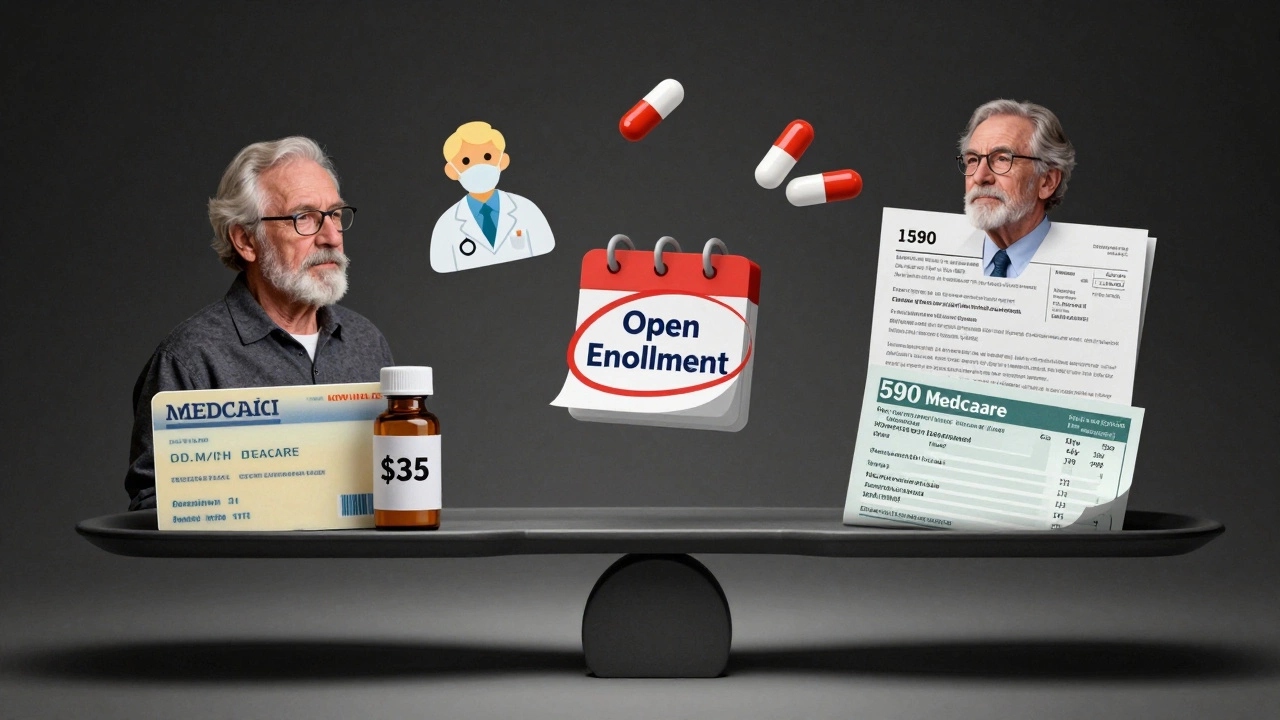
Skipping Medicare when you’re first eligible can cost you. If you don’t sign up for Part B when you should-and you don’t have other credible coverage-you’ll pay a late enrollment penalty. That’s 10% extra for every full 12-month period you delay. So if you wait three years, your Part B premium becomes $221 instead of $170. And that penalty lasts for as long as you have Medicare.
Same goes for Part D. If you go without creditable prescription drug coverage for more than 63 days after your Initial Enrollment Period, you’ll pay a penalty when you finally sign up. It’s calculated as 1% of the national base premium ($35 in 2026) for each month you were without coverage. That adds up fast.
Real People, Real Costs
Take Maria, 68, from Ohio. She’s on Social Security and gets Medicaid. Her Part B premium? $0. Her Part D plan? $12 a month. Her insulin? $35 a month. Total monthly Medicare-related cost: $47.
Then there’s Robert, 72, from California. He’s a retired engineer with a pension and investments. His income puts him in the top IRMAA tier. His Part B: $590. His Part D: $85. His brand-name blood pressure med? $120 a month. Total: $795.
And then there’s Lisa, 66, still working with employer insurance. She’s not enrolled in Medicare yet. She pays nothing to Medicare-just her employer plan. She’ll enroll when she retires next year. No penalties. No surprises.
There’s no single Medicare cost. There’s no universal $170 bill. What you pay depends on your life, your income, your medications, and your choices.
How to Find Your Real Cost
Don’t guess. Don’t assume. Log into your Medicare.gov account (you’ll need your Social Security number). You’ll see your exact premiums, any IRMAA charges, and your Part D plan details. You can also call 1-800-MEDICARE (1-800-633-4227) and ask for a personalized cost breakdown.
Use the Medicare Plan Finder tool. Enter your prescriptions, your zip code, and your income. It will show you every plan available to you-including ones with $0 premiums and low drug costs. You might be surprised how much you can save.
If you’re unsure about income thresholds or appeals, contact your State Health Insurance Assistance Program (SHIP). They’re free, local, and trained to help you navigate Medicare. No sales pitches. No pressure. Just answers.
Bottom Line: You’re Not Paying What Everyone Else Pays
Medicare isn’t one-size-fits-all. The $170 monthly figure is a starting point-not a ceiling or a floor. Most people pay less. Some pay a lot more. And if you’re paying more than you should, you can fix it.
Check your income status. Review your drug plan. Apply for extra help if you qualify. Don’t wait until you get a bill you can’t afford. Medicare’s system is complex, but it’s designed to be flexible. You just have to take the first step.
Do all Medicare recipients pay $170 a month?
No. The $170 is the standard Part B premium for most people in 2026, but many pay less-some $0-because of low income or Medicaid. Others pay more-up to $590-if their income exceeds certain limits. What you pay depends on your income, enrollment timing, and whether you have extra help.
Is Medicare Part D always expensive?
Not at all. The average Part D premium in 2026 is about $35. Many low-income enrollees pay $0 thanks to Extra Help from Medicare. Even if your plan has a higher premium, your out-of-pocket drug costs may be low if your medications are on the plan’s formulary. Always compare plans during Open Enrollment.
Can I get help paying for Medicare if I’m on a fixed income?
Yes. If your income is below $21,590 (individual) or $29,160 (couple) in 2026, you may qualify for Extra Help-a federal program that lowers Part D premiums, deductibles, and copays. You may also qualify for a Medicare Savings Program that pays your Part B premium. Apply through your state’s Medicaid office or Social Security.
What if I didn’t sign up for Medicare when I turned 65?
If you didn’t have other credible coverage, you’ll face a late enrollment penalty. For Part B, it’s 10% extra per year you delayed. For Part D, it’s 1% of the national base premium per month without coverage. These penalties stick with you for life. But if you had employer insurance, you may be exempt. Check with Medicare to confirm your situation.
How do I know if I’m paying too much for my prescriptions?
Log into your Medicare.gov account and use the Plan Finder tool. Enter your medications, pharmacy, and zip code. It will show you all available plans and their estimated annual costs. If your current plan’s total cost (premium + drug copays) is higher than others, switch during Open Enrollment. You can also ask your pharmacist if a generic or alternative drug is available.
Does Medicare cover all my medications?
No. Each Part D plan has its own list of covered drugs, called a formulary. Some plans cover more brand-name drugs, others focus on generics. Insulin, antidepressants, and heart medications are usually covered, but not always at the same cost. Always check your plan’s formulary before you enroll. If your drug isn’t covered, you can request an exception.
What to Do Next
If you’re unsure about your Medicare costs, start with these three steps:
- Log into your Medicare.gov account and check your current premiums and drug plan.
- Use the Plan Finder tool to compare plans-especially if you take one or more expensive medications.
- Contact your State Health Insurance Assistance Program (SHIP) for free, personalized advice. Find yours at shiptacenter.org.
Medicare isn’t a mystery. It’s a system built to adapt to your life. But you have to engage with it. Don’t wait for a surprise bill. Take control now-your wallet will thank you.