
The Core Strengths of Public Care
If you're dealing with a catastrophe-a heart attack, a stroke, or a complex trauma-England's public system is genuinely elite. The level of coordination between emergency services and A&E (Accident and Emergency) departments is impressive. You won't find the 'medical bankruptcy' that plagues the US system. In England, the government funds the system through general taxation, which removes the financial barrier to entry for basic care. Primary care is the first line of defense. Your General Practitioner (GP) acts as a gatekeeper. They handle everything from vaccinations to managing chronic conditions like diabetes. For most people, this works well. You get a local doctor who knows your history. The quality of clinical guidelines is high, meaning that whether you're in London or a small village in Cumbria, you'll likely receive the same evidence-based treatment for a specific condition.Where the System Struggles
It's not all smooth sailing. The biggest pain point is the wait. Elective surgeries-things that aren't life-threatening but affect your quality of life-are where the system lags. For instance, if you have a cataracts surgery or a hip replacement, you might be on a list for 18 weeks or significantly longer. This is largely due to a backlog that grew during the early 2020s and hasn't fully cleared. Staff burnout is another critical issue. Nurses and doctors are often overworked, which can lead to shorter consultation times. You might feel like you're being rushed through a 10-minute appointment with your GP. While the medical advice is usually sound, the 'human' side of care-the time to talk through your anxieties-often takes a hit. This is why many people start looking for alternatives to avoid the feeling of being just another number in a queue.The Rise of Private Healthcare Insurance
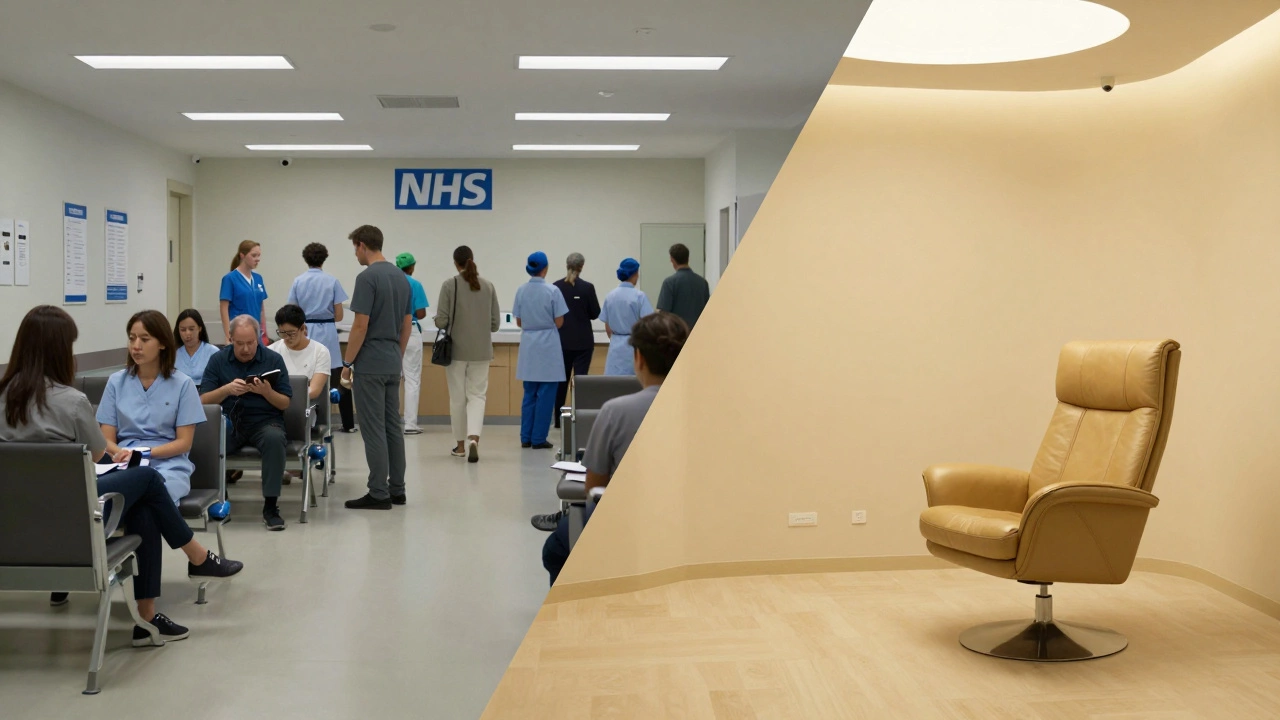
Because of these delays, more people are turning to Private Healthcare Insurance, which is a contractual agreement where a provider covers the cost of medical treatment in private hospitals in exchange for a monthly premium. This doesn't replace the NHS; it's a supplement. In England, the two systems coexist. You still use the NHS for emergencies, but you use your insurance for planned procedures. Private care offers two main advantages: speed and choice. Instead of waiting six months for a specialist, you might see one in six days. You also get to choose your consultant and often stay in a private room with better amenities. It's less about the *quality* of the surgery-since many private consultants also work for the NHS-and more about the *experience* and the *timing* of the care.| Feature | NHS (Public) | Private Insurance |
|---|---|---|
| Cost at Point of Use | Free (Tax-funded) | Premium-based / Co-pay |
| Emergency Care | World-class / Primary | Limited (Usually redirects to NHS) |
| Wait Times (Elective) | Can be long (months/years) | Very short (days/weeks) |
| Doctor Choice | Assigned/Limited | High flexibility |
| Facilities | Standard Wards | Private Rooms/Hotel-like |
Making the Choice: Is Insurance Worth It?
Deciding whether to pay for a private policy depends on your health profile and your tolerance for waiting. If you are generally healthy and only need the system for emergencies, the NHS is more than enough. However, if you have a family history of conditions that require regular screenings or specialized chronic management, the peace of mind provided by insurance is valuable. Consider a scenario where a professional in their 40s develops a sports injury. Under the NHS, they might wait months for an MRI and subsequent physiotherapy, potentially losing income due to inactivity. With Private Medical Insurance (PMI), they could have the scan and first session within a week, getting back to work faster. In this case, the insurance isn't just about health-it's about economic productivity. One thing to watch out for is 'pre-existing conditions.' Most private insurers won't cover a problem you already had before you signed up. If you already have chronic back pain, your insurance likely won't pay for that specific treatment, meaning you're back to using the NHS for that particular issue.The Role of the GP and Specialist Referrals
Regardless of which path you choose, the General Practitioner is the heart of the system. In the NHS, you cannot simply walk into a hospital and ask for a cardiologist; you need a referral. This prevents the system from being overwhelmed by people seeking unnecessary specialist care. In the private sector, some policies allow 'direct access' to certain specialists, while others still require a GP referral to trigger the insurance payout. It's a critical administrative step. If you skip the referral process, you might find yourself paying the full bill out of pocket because the insurance company refuses to reimburse a 'self-referred' visit.
Looking at the Future of Care
England is moving toward a more digital-first approach. Telehealth and online consultations have become standard, reducing the need for physical travel for simple follow-ups. This is helping to ease the pressure on physical clinics. We're also seeing a shift toward 'integrated care systems,' where hospitals and community services work more closely to keep people out of the hospital in the first place. But the fundamental tension remains. The NHS is a symbol of social solidarity-the idea that we all look after each other. Private insurance is a tool for individual efficiency. As long as the public system is strained, the demand for private options will grow. This doesn't mean the healthcare isn't 'good'; it just means the way you access it depends on your resources.Is the NHS really free?
Yes, for the vast majority of services. You don't pay a bill when you leave the hospital or visit your GP. It is funded through your National Insurance contributions and general taxes. However, there are some fixed charges for things like prescriptions (in England) and dental care, though many groups-like seniors or those on low incomes-are exempt.
Can I use private insurance for emergencies?
Generally, no. In England, emergency care (A&E) is almost exclusively handled by the NHS. If you have a heart attack or a car accident, you go to the nearest NHS hospital. Private insurance is primarily used for 'elective' or planned treatments, such as joint replacements, diagnostic scans, or specialist consultations.
Do I need a GP to see a private specialist?
It depends on your insurance policy. Some policies require a GP referral to authorize payment. Others allow you to book a specialist directly. If you are paying out of pocket (self-funding), you can usually book any private consultant you choose without a referral.
What happens if my private insurance doesn't cover a condition?
If a condition is deemed a 'pre-existing' one or falls outside your policy's scope, you can still receive treatment through the NHS. The beauty of the UK system is that the public safety net is always there; you simply move from the private queue back to the public queue for that specific treatment.
Are private doctors better than NHS doctors?
Not necessarily. In fact, most private consultants are senior NHS doctors who simply set aside a few hours a week to see private patients. You are often seeing the exact same surgeon. The difference is the environment, the waiting time, and the amount of time the doctor can spend with you during the appointment.